NARRATIVE REVIEW ARTICLE
José Martí and his death: a view from Medicine. A narrative review
José Martí y su muerte: una mirada desde la Medicina. Revisión narrativa
Andy Guillermo Paumier Durán 1, https://orcid.org/0000-0002-9709-9056
Yanier Espinosa Goire 1*, https://orcid.org/0000-0003-1026-7932
Dariel Marín González 1, https://orcid.org/0009-0003-5629-6533
Alexander Benavides Jiménez 1, https://orcid.org/0009-0008-0239-7415
1 University of Medical Sciences of Guantánamo. Faculty of Medical Sciences Guantánamo. Guantánamo, Cuba.
* Corresponding author: espinosagoireyanier@gmail.com
Received: 25/10/2025
Accepted: 27/04/2026
Published: 05/05/2026
How to cite this article: Paumier-Durán AG, Espinosa-Goire Y, Marín-González D, Benavides-Jiménez A. José Martí and his death: a view from Medicine. A narrative review. MedEst. [Internet]. 2026 [cited access date; 6:e438. Available in: https://revmedest.sld.cu/index.php/medest/article/view/438
ABSTRACT
Introduction: The death of José Martí in Dos Ríos (1895) is controversial. Theories include his being targeted, suicide, military pride, or being finished off after falling wounded.
Objective: To describe hypotheses, historical facts, and analyze medical reports from a current forensic perspective.
Methods: A narrative review of 22 sources (1895-2023) from the National Archives, SciELO, MedlinePlus, LILACS, Google Scholar, and books. MeSH terms used: Autopsy, Cadaver, Death Certificate, Exhumation, History. Inclusion criteria were applied, prioritizing official documents, forensic analyses, and historical studies.
Results: Two hypotheses: direct death in combat from three gunshot wounds while riding (supported by official documents and biomechanical analysis) versus death by being finished off (uncorroborated testimony of Antonio Oliva). The death certificate describes wounds to the chest, neck, and right leg, without internal trajectories. The exhumations confirmed fractures of the tibia and fibula, but the viscera were lost. Analysis by Cobo Abreu and Vento Canosa supports direct death, but limitations prevent a definitive conclusion.
Conclusions: The 1895 forensic examinations were incomplete (partial autopsy, loss of viscera, lack of chain of custody). The evidence favors direct death, but is not conclusive. Future studies using images of skeletal remains and searches in Spanish archives could resolve the case. This underscores the forensic pathologist's responsibility to history and the importance of a thorough forensic examination.
Keywords: Autopsy; Cadaver; Death Certificate; Exhumation; History; Forensic Medicine.
RESUMEN
Introducción: La muerte de José Martí en Dos Ríos (1895) es controvertida. Las teorías incluyen su exposición como blanco, suicidio, orgullo militar o remate tras caer herido.
Objetivo: Describir hipótesis, hechos históricos y analizar dictámenes médicos desde perspectiva forense actual.
Métodos: Revisión narrativa de 22 fuentes (1895-2023) del Archivo Nacional, SciELO, MedlinePlus, LILACS, Google Scholar y libros. Se usaron DeCS: Autopsia, Cadáver, Certificado de Defunción, Exhumación, Historia. Se aplicaron criterios de inclusión, jerarquizando documentos oficiales, análisis de legistas y estudios históricos.
Resultados: Dos hipótesis: muerte directa en combate por tres impactos mientras cabalgaba (respaldada por documentos oficiales y análisis biomecánicos) versus muerte por remate (testimonio no corroborado de Antonio Oliva). El certificado de defunción describe heridas torácica, cervical y en pierna derecha, sin trayectorias internas. Las exhumaciones confirmaron fractura de tibia y peroné, pero las vísceras se perdieron. Análisis de Cobo Abreu y Vento Canosa apoyan muerte directa, pero las limitaciones impiden conclusión definitiva.
Conclusiones: Los exámenes forenses de 1895 fueron incompletos (autopsia parcial, pérdida de vísceras, sin cadena de custodia). La evidencia favorece la muerte directa, pero no es concluyente. Futuros estudios con imagen de restos óseos y búsqueda en archivos españoles podrían resolver el caso. Esto subraya la responsabilidad del legista ante la historia y la importancia de un examen forense completo.
Palabras clave: Autopsia; Cadáver; Certificado de Defunción; Exhumación; Historia; Medicina Legal.
INTRODUCTION
The death of José Martí continues to be the subject of debate due to the ambiguous circumstances surrounding the event. Over time, various hypotheses have been proposed, although none has achieved definitive consensus. The main theories include: his fiery speech making him a visible target, a possible act of suicide, and a military motivation driven by personal pride and reckless courage. Among these, the one that seems most faithfully to reflect the Apostle's personality is based on his revolutionary trajectory, his persistent ideals, and the content of his unfinished letter to Manuel Mercado. Likewise, the death certificate —which records the intensity of the enemy fire and his proximity to it— provides contextual evidence that allows a more coherent explanation of the incident. (1)
The vast bibliographic production generated since the Master's death at Dos Ríos has analyzed testimonies and documents from the era; nevertheless, contradictory interpretations and various misunderstandings have kept the case in obscurity to this day. This controversy could be attributed to disagreements that arose at different historical moments regarding how the event should be assessed. The most rigorous investigations into José Martí's death have lacked, however, a contemporary forensic analysis that could provide conclusive data. This limitation suggests the need to complement existing knowledge through a medical-pathological perspective, which would allow —through anatomical studies— the precise determination of the projectile impact zones and the characteristics of the wounds suffered. (2)
A relevant fact in this context is that José Martí's body was exhumed 96 hours after his death, and an embalming technique advanced for the time, little known locally then, was performed on him. (2)
Given the nature of the object of study —a historical event documented primarily through primary sources (records, certificates, testimonies, correspondence) and retrospective analyses without the possibility of applying experimental methodologies— the narrative review design is the most appropriate. Unlike a systematic review, this approach allows for the critical integration of heterogeneous evidence (historical, medico-legal, biographical), exploration of unresolved controversies, and generation of interpretations grounded in the available literature, without intending to exhaust all evidence or apply meta-analysis. Likewise, the narrative review facilitates the identification of knowledge gaps and the formulation of explanatory hypotheses regarding the events surrounding the Apostle's death.
The present study seeks to foster interest in continuing to deepen this crucial chapter of the Apostle's life. Given the scant knowledge that exists in the health field on this topic, a narrative review was conducted with the objective of describing the hypotheses, writings, and historical facts linked to his fall in combat, as well as analyzing the available medical reports from a current forensic perspective.
METHODS
Study type
A narrative review of the scientific and historical literature on the death of José Martí was conducted, with an emphasis on medico-legal and forensic aspects. This methodological design was selected due to the heterogeneous and qualitative nature of the available sources (archival documents, death certificates, exhumation records, historical testimonies, and retrospective medical analyses), which are not suitable for a quantitative meta-analysis synthesis or a systematic review with formal risk of bias assessment.
The review was oriented to answer the following question: What are the hypotheses, documentary findings, and medico-forensic interpretations available on the death of José Martí at Dos Ríos (May 19, 1895)?
Bibliographic search strategy
Search period: Sources published between 1895 (year of death) and December 2023 were consulted, with no initial date restriction to allow the inclusion of foundational historical documents.
Databases consulted:
· Health sciences: SciELO (Scientific Electronic Library Online), MedlinePlus (via PubMed), LILACS (Latin American and Caribbean Literature in Health Sciences).
· Historical sources and archives: National Archive of Cuba (printed and digital publications), José Martí National Library, repository of the University of Medical Sciences of Guantánamo.
· General literature: Google Scholar (complementary search).
Search terms: Health Sciences Descriptors (DeCS) and their English equivalents (MeSH when available) were used:
· Spanish: Autopsia, Cadáver, Certificado de Defunción, Exhumación, Historia, Medicina Legal.
· English: Autopsy, Corpse, Death Certificate, Exhumation, History, Forensic Medicine.
· Boolean operators: AND and OR (e.g., "José Martí" AND (death OR exhumation OR autopsy); "death certificate" AND "José Martí").
Languages: Sources in Spanish and English were included, as they are the predominant languages in the specialized literature on the subject and in archival documents.
Source selection criteria
Inclusion criteria:
· Original primary documents: death certificate, exhumation records (1895 and 1907), medical reports from the era.
· Articles from indexed scientific journals (original or review) addressing Martí's death from a medical, forensic, or historical perspective.
· Books and book chapters published by academic publishers or official Cuban institutions.
· Testimonies of direct participants in the events (e.g., Antonio Oliva, General Gómez), provided they were documented in verifiable sources.
· Publications of the National Archive of Cuba ("Centenario del Natalicio de José Martí" series).
Exclusion criteria:
· Journalistic sources not supported by reliable primary or secondary documentation.
· Fictional or non-academic works without references to original documents.
· Documents whose authorship or provenance could not be verified.
· Anonymous publications without date or institutional affiliation.
Hierarchy of evidence: Given the historical nature of the topic, the following order was prioritized:
· Level 1: Original official documents (death certificate, notarial records, military reports).
· Level 2: Analyses by contemporary forensic physicians (e.g., Antonio Cobo Abreu, Ercilio Vento Canosa) published in peer-reviewed journals or books.
· Level 3: Historical studies with documentary support (e.g., Joel James Figarola, Rolando Rodríguez).
· Level 4: Direct testimonies cited in secondary sources.
Selection process
Reviewers: Two authors independently performed the search and pre-selection of titles and abstracts. A third and fourth author acted as expert reviewers in the history of medicine to resolve disagreements.
Procedure: The selection process was developed in five sequential stages. In the first stage, sources were identified through database and archive searches, yielding a total of 78 initial records. Next, in the second stage, duplicates were removed, of which 12 were identified, leaving 66 records for evaluation. In the third stage, titles and abstracts were evaluated applying the predefined inclusion and exclusion criteria; of the 66 records reviewed, 35 were excluded for not directly addressing the object of study or for being thematic duplicates, resulting in 31 potentially eligible sources. In the fourth stage, the full text of these 31 sources was read. Finally, in the fifth stage, after definitively applying the inclusion criteria, 22 sources were selected, the selection flow of which is summarized in Figure 1 (descriptive flow diagram).
Note: As this is a narrative review, a full PRISMA diagram or PROSPERO registration was not required.
Data extraction and synthesis
Variables extracted: For data extraction, a matrix was designed to record, from each included source, the following information: author(s), year of publication, type of source (primary document, scientific article, or book), the hypothesis proposed about Martí's death, the description of wounds and ballistic trajectory according to the author, the forensic examination methods used (autopsy, exhumation, identification), as well as the medical conclusions and limitations stated by the authors themselves.
Synthesis method: For information synthesis, a mixed approach (thematic and chronological) was employed. The findings were organized into six main categories. First, the historical context of the Battle of Dos Ríos was addressed, followed by the presentation of the two main explanatory hypotheses regarding the Apostle's death. Next, the complete content of the death certificate and its analysis were included. Subsequently, the exhumation and embalming procedures carried out in 1895 were described, followed by the second exhumation that occurred in 1907 and the corresponding bone findings. Finally, the contemporary medico-legal analysis available in the reviewed literature was integrated. This organization allowed for a sequential and logical presentation of both the chronological evolution of events and the diversity of medical interpretations of the case.
RESULTS
Historical context of the Battle of Dos Ríos
On May 13, 1895, the mambí troops set up their camp in the abandoned ranches of the Pacheco brothers, between Bijas and Dos Ríos, where José Martí awaited the arrival of General Bartolomé Masó. (3) During the afternoon of May 18, while Martí was writing his unfinished letter to Manuel Mercado, Masó arrived at the camp; the Apostle interrupted his writing and kept the document in his frock coat. (3) General Gómez, for his part, had left the previous day with about 40 mambises towards Ventas de Casanova to ambush a Spanish column commanded by Colonel Ximénez de Sandoval, although the column managed to pass undetected. (4)
On the morning of May 19, Gómez returned to camp and, after a brief greeting to Masó, held a conference with Martí and Masó. After a military inspection in which about 400 mambises heard the exhortations of Gómez and Masó —Martí did not give a formal speech but a revolutionary exhortation— and after lunch, they were about to rest when Lieutenant Álvarez arrived with news of gunfire towards Dos Ríos. Gómez immediately ordered "To horse!" and rode into combat, followed by Paquito Borrero, Martí, Masó, and the rest of the troops. (3,4)
Circumstances of the fall in combat
General Gómez warned Martí —who was wearing a black coat, light trousers, a black beaver hat, and black half-boots, galloping at his side— to withdraw to the rear, because that front line was not his place. Gómez recognized that Martí, although overflowing with combativeness, lacked the martial skills of the mambí horsemen. However, the most determining factor was the transcendent value of Martí's life for the revolutionary cause. Given the intensity of the Spanish defense, which foreshadowed a retreat, Martí decided to advance heroically, probably with the conviction that his personal example would instill morale in the troops. (5)
Far from obeying the order to fall back, Martí —accompanied by Ángel de la Guardia— galloped towards enemy fire. He carried only a Colt revolver with a mother-of-pearl grip, a gift from Panchito Gómez Toro, from which no shots were fired. Both horsemen positioned themselves approximately fifty meters to the right and in front of General Gómez, becoming an obvious target for the Spanish advance guard hidden in the thicket. While passing between a dry dagame tree and a fallen stout fustete, the shots from the ambush struck the Master's body. Martí let go of the reins and fell onto Cuban soil. His aide, Ángel de la Guardia, escaped unharmed and reported the event to Gómez, who was unable to recover the body. (4,5)
Hypotheses about the death
In the reviewed literature, two hypotheses have received greater attention. The first hypothesis holds that Martí was killed directly in combat, a victim of the ambush and the heavy point-blank fire, as the Spanish forces were camped and waiting for the insurgents. (3) This version is based on Colonel Ximénez de Sandoval's military report and Dr. Valencia's death certificate (official and contemporary documents). The second hypothesis suggests that he fell wounded and was then finished off by his enemies. Its main support comes from the testimony of Antonio Oliva, known as "Mulato," a guide for the Spanish troops, who claimed to have shot the Master while he lay wounded on the ground. (3)
Critical analysis of the hypotheses. From a methodological perspective, both hypotheses present substantial differences in the quality of the evidence supporting them. The first is supported by official primary sources (military and medical documents drafted immediately after the battle), while the second rests on a single, isolated, uncorroborated testimony from a soldier on the enemy side, which introduces a potential bias of self-exculpation or self-aggrandizement of his participation. Subsequent medico-legal analyses, such as that of Dr. Antonio Cobo Abreu, have tended to support the first hypothesis through biomechanical studies of projectile trajectories (Table 1). (7)
Table 1. Comparison of the two main hypotheses about the death of José Martí
|
Aspect |
Hypothesis 1: Direct death in combat |
Hypothesis 2: Death after being finished off |
|
Main author supporting it |
Ximénez de Sandoval, Gómez, Valencia |
Antonio Oliva ("Mulato") |
|
Type of evidence |
Official documents (military report, certificate) |
Single personal testimony |
|
Trajectory of shots |
Three impacts simultaneously or in rapid succession |
Initial impact (neck/leg), then chest execution |
|
Martí's position at mortal impact |
Mounted on horseback |
On the ground (supine or semi-seated) |
|
Credibility of the source |
High (multiple concordant contemporary sources) |
Low (uncorroborated testimony, potential bias) |
|
Authors who support it |
Cobo Abreu, Vento Canosa |
James Figarola (with reservations) |
Source: Authors' own elaboration.
Death certificate: documentary analysis
The report issued by Dr. Pablo A. de Valencia, a Spanish physician, constitutes the fundamental medico-legal document. The certificate is transcribed verbatim below.
Valencia certifies that, after exhumation of the body on May 23, 1895 at 5:30 p.m., he identified the body by physical characteristics coinciding with data provided by persons who knew Martí: apparent age 45-50 years, regular height, curly dark brown hair, baldness on the crown, broad forehead, light-colored eyes, aquiline nose, teeth with absence of the second right upper incisor, and marks on the legs indicative of having worn shackles.
The described wounds were (Figure 1):
1. A penetrating gunshot wound to the chest, with an entrance hole in the anterior part of the thorax at the level of the sternum (fractured) and an exit hole in the right fourth intercostal space 10 cm from the vertebral column.
2. Another gunshot wound to the neck, with entrance below the chin 15 cm from it and 4 cm from the mandibular ramus, and exit above the right upper lip, with destruction of the wound edges.
3. Another gunshot wound in the lower third of the right leg, on its inner side.
4. Several contusions on the rest of the body.
Critical analysis of the certificate. Although the document is valuable for being contemporary and official, it has significant limitations from a current forensic perspective: the exact trajectory of the projectiles inside the body is not described, the direction of the shots is not specified (only entry and exit points), and the advanced state of putrefaction could have hindered the precision of the observations. Furthermore, as the authors of this article point out, the examinations were not entirely complete enough to explain the Apostle's final moments.
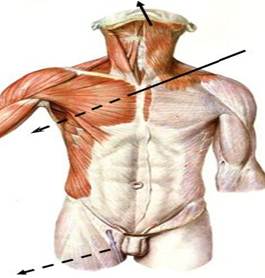
Figure 1. Schematic representation of the gunshot wounds described in the death certificate issued by Dr. Pablo A. de Valencia (1895).
Ballistic reconstruction according to contemporary analyses
Dr. Antonio Cobo Abreu, a Cuban forensic expert, conducted a biomechanical analysis of the injuries. His conclusions establish the following sequence (7):
First impact: to the thorax, with Martí mounted and his torso flexed forward (Figure 2).
Second impact: to the neck, with his torso upright and his head in hyperextension (a possible consequence of the first impact).
Third impact: to the inner side of the right leg, during the fall, when the limb crossed over the horse's back.
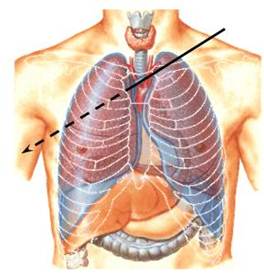
Figure 2. Anatomical structures involved in the trajectory of the first ballistic impact (thorax), according to the reconstruction by Dr. Antonio Cobo Abreu.
This reconstruction is consistent with the pictorial representation by the artist Esteban Valderrama (Figure 3). In contrast, the hypothesis of the finishing blow would imply that the chest shot occurred while Martí was on the ground, altering the angle of entry—a fact incompatible with the original descriptions, according to Cobo Abreu.
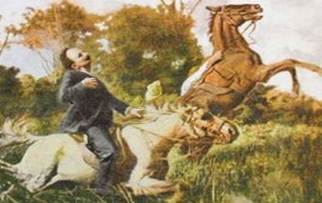
Figure 3. Oil painting by the painter Esteban Valderrama illustrating Dr. Antonio Cobo Abreu's hypothesis on the position of José Martí when he received the bullet impacts.
Dr. Ercilio Vento Canosa, for his part, proposed that the causes of death, in modern terms, would be: acute anemia secondary to injuries of the arterial and venous vessels of the superior mediastinum, as a consequence of a gunshot wound to the thorax. The neck wound, although serious, would have allowed for a brief period of agonizing survival, but the intrathoracic hemorrhage was incompatible with life. (13)
First Forensic Examination and Exhumation (1895)
General Juan Salcedo sent Dr. Pablo Aureliano de Valencia y Forns to Remanganaguas to identify the body and prepare it for transport to Santiago de Cuba. Valencia was the son of Dr. Pablo Valencia y García, Professor of Anatomy at the University of Havana, known for his role in denouncing the medical students executed in 1871. (15) This contextual information adds an ethical dimension to the Spanish doctor's intervention.
The exhumation took place on May 23 at 5:30 p.m., after more than 72 hours of burial. Martí's body and that of a Spanish sergeant who shared the mass grave were in an advanced state of decomposition. Valencia made an abdominal incision to remove the viscera (which, according to some reports, remained in the Remanganaguas cemetery) and filled the cavity with cotton after disinfecting the remains. (15,16) He then applied 302 injections of mercuric chloride at a concentration of 1:600 and coated the body with a solution of alum and salicylic acid in boiling water, forming a varnish-like layer (Figure 4). This procedure, advanced for the time, allowed for the transport on stretchers to Santiago de Cuba, although during the journey the Spanish troops were harassed by Mambí forces without managing to recover the body. (16)
Limitations of the first forensic examination. Valencia did not use gloves (although there is no explicit record, this is likely given the period), and modern chain of custody procedures were not followed. The removed viscera were never recovered for later study. Furthermore, the primary objective was identification and preservation, not a thorough forensic autopsy.
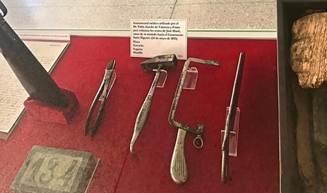
Figure
4. Surgical
instruments used by Dr. Pablo Aureliano de Valencia y Forns during the
exhumation and preparation of the body of José Martí (Remanganaguas, May 23,
1895).
Second exhumation (1907)
On February 24, 1907, in commemoration of the Grito de Baire (Cry of Baire), the Civil Governor of Oriente, Francisco Pérez Carbó, established the "Martí's Remains" commission. Eyewitnesses to the first exhumation included two colonels of the Liberation Army (Pedro Echevarría Sánchez and Guillermo Fernández) and Dr. Antonio Illas Portuondo, the local health chief. (20) Before notary Donato Valiente y Portuondo, niche 134 of the Santa Ifigenia Cemetery was opened. Dr. Guillermo Fernández Mascaró took the skull and displayed the remains, confirming that they were complete according to the experts (Figure 5).. (19,20)
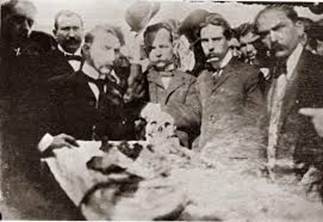
Figure 5. Exhumation of Martí's remains on February 24, 1907. Among those present were Dr. Guillermo Fernández Mascaró and José Francisco Martí Zayas Bazán, son of the Apostle.
The skeletal examination revealed a gunshot wound that had caused a complete fracture of the upper third of the right tibia and fibula. The rest of the skeleton showed no apparent injuries, although some ribs appeared broken—presumably due to decomposition. The remains were placed in a lead urn along with a glass tube containing a copy of the notarial deed, and the urn was sealed inside a mahogany urn to be returned to the same niche. (19,20)
Importance of the skeletal find. The fracture of the tibia and fibula confirms the wound in the right leg described in 1895, validating the original description. However, no injuries were found in the skull or ribs that would allow for a definitive determination of the exact trajectory of the thoracic and cervical projectiles, which leaves some controversy unresolved.
Integrative Synthesis and Gaps in Knowledge
The available evidence largely supports the hypothesis of direct death in combat (three bullet wounds while mounted), as opposed to the theory of a final, decisive blow. However, questions remain that could not be answered by the forensic examinations of the time: Was the order of the bullet wounds as inferred by Cobo Abreu, or could it have been different? Was the cervical wound immediately fatal, or did it allow Martí to linger for a few minutes? Why hadn't the revolver been fired? Does this reflect a conscious decision not to use it, or was he simply overwhelmed by events? Is it possible to re-examine the skeletal remains using modern techniques (CT scans, DNA analysis) to obtain more information?
These questions constitute avenues for future research that could be explored if access were gained to the Apostle's remains, currently interred in the monument at Santa Ifigenia Cemetery.
DISCUSSION
This narrative review has integrated the main available historical and medico-legal evidence regarding the death of José Martí in Dos Ríos, with the purpose of describing the hypotheses, writings, and events related to his death in combat, as well as analyzing the medical reports from a current forensic perspective. The most relevant findings indicate that: (a) there are two main hypotheses—direct death in combat versus death after being wounded and then finished off—, (b) the death certificate issued by Dr. Valencia constitutes the most complete primary documentary source, although with limitations, (c) contemporary biomechanical analyses largely support the hypothesis of a triple impact while Martí was riding, and (d) the two exhumations (1895 and 1907) confirmed the described wounds but did not resolve all the controversies. These results are discussed below in light of the existing literature, methodological limitations are analyzed, and implications for future research are proposed.
The reconstruction of the circumstances of Martí's death has been the subject of debate for over a century. Two interpretative currents have predominated. On the one hand, the official version, based on Spanish military reports and Valencia's certificate, holds that Martí died instantly from bullet impacts received while riding. On the other hand, the version supported by the testimony of Antonio Oliva ("Mulato"), who claimed to have finished off the wounded Apostle on the ground. The results of this review show that the first hypothesis has significantly greater documentary support and biomechanical analyses that give it anatomical coherence. The second hypothesis, although persistent in less rigorous historiography, lacks independent corroboration and comes from a source with obvious partisan bias.
These findings coincide with those reported by Rojas-Pérez and colleagues (1), who, after analyzing documents from the National Archive, concluded that the intensity of enemy fire and Martí's advanced position adequately explain the three impacts without needing to postulate a finishing shot. Likewise, Méndez-Blanco and colleagues (2) noted that the absence of shots from Martí's revolver —a finding consistent across all primary sources— disfavors the hypothesis of a prior confrontation or a death on the ground with the possibility of defense.
However, other authors, such as James Figarola (8), have defended the possibility of the execution, arguing that the Spanish troops had orders not to leave wounded enemies alive and that Oliva's testimony, although unique, was recorded on multiple occasions without internal contradictions. The discrepancy between the two positions reflects, more than an irreducible factual controversy, a disagreement about the criteria for evaluating historical evidence: while some prioritize contemporary official documents, others give weight to direct testimony, even if isolated and biased.
The biomechanical analysis by Cobo Abreu (7) has been the most influential in Cuban medico-legal literature. His conclusions on the sequence of shots —chest first, neck second, leg as he fell— have been accepted by most subsequent authors, including Vento Canosa (13), who added the specification of the causes of death in current pathophysiological terms (acute anemia due to injury to the great vessels of the superior mediastinum). Our review finds that these analyses, although logically coherent, are based on the description of the wounds contained in Valencia's certificate and the exhumation records, without direct access to the skeletal remains for modern imaging studies. As critically noted by Hodelín Tablada (20) and others, none of the reconstructions have been able to be verified with contemporary forensic techniques (computed tomography, 3D ballistic trajectory analysis) due to the current inaccessibility of the remains.
Regarding the exhumation procedures, Ibarra Martínez (16) meticulously documented the embalming techniques used by Valencia, highlighting their advanced nature for the time (injections of mercuric bichloride, alum solution, and salicylic acid). Nevertheless, Puente Duany (17) had already pointed out that these techniques, although effective for surface preservation, did not prevent putrefaction of the viscera, which explains why Valencia discarded the viscera in Remanganaguas. This fact —the irreversible loss of internal organs— constitutes a definitive limitation for any future toxicological or histopathological analysis.
It is necessary to distinguish, within the analyzed documentary corpus, between different levels of quality and reliability. The highest-level sources are the contemporary official documents: the report of Colonel Ximénez de Sandoval (9), Dr. Valencia's death certificate (10, 12), and the notarial record of the second exhumation (20). These documents were drafted close to the time of the events, by persons with an obligation of truthfulness (though not exempt from institutional bias), and are preserved in accessible public archives.
At an intermediate level are the analyses of forensic experts and historical studies based on primary sources (7, 8, 13). Their value is high in terms of interpretation, but they depend completely on the accuracy of the primary sources they employ. At a lower level are non-contemporary or uncorroborated oral testimonies, such as that of Antonio Oliva (3), whose veracity cannot be independently verified and which presents obvious biases (affiliation with the enemy side, interest in exaggerating his role, lack of additional documentation).
An important limitation of the reviewed evidence is that no primary source accurately describes the internal trajectory of the projectiles (damaged structures, order of injury). Valencia's certificate (12) indicates entry and exit holes but does not detail which vessels, nerves, or viscera were severed. This deficiency imposes an insurmountable limit on any reconstruction, no matter how sophisticated its biomechanical methodology.
The authors themselves recognize several methodological limitations that must be taken into account when interpreting the results. First, bibliographic selection bias: the search was limited to sources in Spanish and English, with a predominance of Cuban literature. There may be relevant documents in Spanish archives (General Military Archive of Madrid, National Historical Archive) or in publications in French, German, or Italian that were not consulted. Second, access restrictions: it was not possible to directly access the documentary collections of the Spanish Ministry of Defense or the original records of the Spanish military health corps from 1895, which might contain additional reports not included in the publications of the National Archive of Cuba.
Third, dependence on previous interpretations: the biomechanical analyses of Cobo Abreu (7) and Vento Canosa (13) were accepted as valid without the possibility of independent reevaluation, given that the skeletal remains are not available for new studies. Fourth, lack of formal risk of bias assessment of historical sources, which, although not required in narrative reviews, could have added rigor. Fifth, the eminently qualitative nature of the synthesis prevents the establishment of quantitative causal associations or the calculation of probabilities regarding which hypothesis is more plausible.
Unlike a systematic review, this work did not include a registered protocol or a full PRISMA diagram, which is appropriate for a narrative design but reduces the reproducibility of the selection process.
Despite its limitations, this review offers several lessons applicable both to medical historiography and to contemporary forensic practice. First, it constitutes a paradigmatic example of the importance of a complete and systematic forensic examination. As the conclusions of this article note, the examinations performed in 1895 were not entirely complete; a more rigorous autopsy protocol, with detailed description of trajectories, fixation of organs, and preservation of samples, would have allowed the controversies still open 130 years later to be definitively answered. This lesson is applicable to any current violent death scene: the quality of the initial forensic report determines the possibility of resolving future controversies.
Second, the case illustrates the need to preserve the chain of custody and preserve biological samples (viscera, tissues, bone fragments) for later analysis with techniques not yet available at the time of the autopsy. The fact that Valencia discarded the viscera in Remanganaguas represents an irreversible loss of potential information.
Third, for historical research in medicine, this review demonstrates the usefulness of integrating documentary sources of different natures (military, notarial, medical) with contemporary technical analyses (biomechanics, ballistics), as well as the need to critically evaluate the level of evidence of each source, rather than uncritically accepting testimonies or documents because of their age or authority.
Based on this review, several areas are identified where current knowledge is insufficient and additional research is required:
- Re-examination of skeletal remains with modern techniques. If Cuban authorities authorized a new study of Martí's bones (currently in the monument at Santa Ifigenia Cemetery), multi-slice computed tomography and microtomography could precisely determine projectile trajectories, identify residual metal fragments, and reconstruct impact angles in three dimensions. This would be the definitive study to resolve the controversy between the two hypotheses.
- Search in Spanish military archives. There is a possibility that documents not consulted in the General Military Archive of Madrid or the Army Museum Archive contain additional medical reports, wound sketches, or testimonies not included in Cuban publications. A systematic review of these collections (with archival methodology) could provide new primary evidence.
- Experimental ballistic analysis. Using replicas of period weapons (Colt revolver, Spanish rifles) and mannequins in Martí's estimated position, experimental shots could be performed to determine whether the distribution of the three impacts is compatible with a single shooter position or requires multiple angles.
- Reliability studies of historical testimonies. Apply methodologies from testimony psychology and oral history to evaluate the credibility of Antonio Oliva's account, contrasting his memory with known biases (self-superiority bias, self-exculpation bias) and verifying its internal consistency across the different recorded versions.
- Ethical reevaluation of Dr. Valencia's conduct. Beyond the controversy over the circumstances of death, Valencia's role —son of the informer of the medical students executed in 1871— as the physician who handled Martí's remains deserves an analysis from the perspective of medical ethics and historical memory.
CONCLUSIONS
The available historical and medico-legal evidence largely supports the hypothesis that José Martí died in combat from three gunshot wounds received while riding, without conclusive proof of a subsequent execution. However, neither hypothesis can be considered definitively proven due to the inherent limitations of the forensic examinations of the era —particularly the lack of a complete autopsy and the irreversible loss of the viscera— as well as the fact that contemporary analyses have had to rely on incomplete descriptions of the wounds. Future studies using advanced imaging techniques on the skeletal remains, together with the location of additional documents in Spanish archives, could contribute to definitively closing this chapter of Cuban history. Meanwhile, Martí's death remains a cautionary example of how an incomplete forensic examination can leave questions unanswered for more than a century, underscoring the forensic physician's responsibility not only to the particular case but also to history.
BIBLIOGRAPHIC REFERENCES
1. Rojas-Pérez M, Martínez-Rojas L, Fernández-Gómez L. Valoración histórica de la muerte de José Martí. Acta Médica del Centro [Internet]. 2012 [cited 20/10/2025]; 6(1):[aprox. 4 p.]. Available in: https://revactamedicacentro.sld.cu/index.php/amc/article/view/715
2. Méndez-Blanco S, Juan-Simón L, Rodríguez-Ramos C, Silvia-Concepción N. Aspectos médicos-legales sobre la muerte de José Martí. Universidad Médica Pinareña [Internet]. 2009 [cited 20/10/2025]; 5(2). Available in: https://revgaleno.sld.cu/index.php/ump/article/view/60
3. Dos Ríos, muerte de Martí. En: Centenario del Natalicio de José Martí. Publicaciones recientes del Archivo Nacional No. XXXVI. La Habana: Archivo Nacional de Cuba; 2007. p. 436.
4. Delgado García G. Martí y los médicos cubanos revolucionarios. Cuadernos de Historia de la Salud Pública, No. 78. La Habana: Editorial Ciencias Médicas; 1993. p. 47-55.
5. Rodríguez García R. Dos Ríos: a caballo y con el sol en la frente. La Habana: Editorial de Ciencias Sociales; 2014.
6. Lozano Ros JJ. Testimonio ofrecido al Dr. Ricardo Hodelín Tablada [Internet]. 2014 [cited 20/10/2025]. Available in: https://sos-de-fra-1.exo.io/patria-libros/books/1_Sociedad_Cultural_Jose_Marti/Enfermedades_de_Jose_Marti.pdf
7. Cobo Abreu A. Consideraciones médico legales sobre la muerte de Martí. En: La muerte de José Martí: análisis multidisciplinario. La Habana: Editorial de Ciencias Sociales; 1989. p. 25-31.
8. James Figarola J. La muerte en Cuba. Plaza de la Revolución, La Habana: Ediciones Unión; 1999.
9. Ximénez de Sandoval J. Carta al general Juan Salcedo, 21 de mayo de 1895. En: Archivo Central/Instituto de Historia y Cultura Militar (AC/IHCM). Capitanía General de Cuba, caja 714. Citado por: Rodríguez R. Martí: los documentos de Dos Ríos. La Habana: Editora Política; 2005. p. 11.
10. De Valencia y Forns PA. Documentos relativos a la exhumación de los restos del Apóstol José Martí. En: Centenario del natalicio de José Martí. Publicaciones recientes del Archivo Nacional No. XXXVI. La Habana: Editorial de Ciencias Sociales; 2006. p. 412.
11. Cobo Abreu A. Consideraciones médico-legales de la muerte de José Martí. La Habana: Editorial de Ciencias Sociales; 1989. p. 434.
12. De Valencia PA, Forns. Acta de defunción de José Martí, 26 de mayo de 1895. En: Centenario del natalicio de José Martí. Publicaciones del Archivo Nacional No. XXXVI. La Habana: Archivo Nacional de Cuba; 1989. p. 434.
13. Vento Canosa E. La cruz de caguairán. Santiago de Cuba: Editorial Oriente; 2003. p. 85.
14. Castellanos G. Los últimos días de Martí. La Habana: Academia de la Historia de Cuba; 1945. p. 318.
15. López Rodríguez O, Morales Tejeda A. Martí en Dos Ríos. La Habana: Editora Política; 1995. p. 22.
16. Ibarra Martínez F. Los cinco entierros de Martí. La Habana: Instituto del Libro; 1968. p. 12.
17. Puente Duany N. Técnicas de autopsia. 3ra ed. La Habana: Instituto del Radio, Hospital Mercedes; 1940. p. 17-20. Citado por: Vento Canosa E. La cruz de caguairán. Santiago de Cuba: Editorial Oriente; 2003. p. 57.
18. Le Roy Gálvez LF. Los médicos Valencia en 1871 y 1895. Patria. 1967 jun;23(6):1-2. (Consultable en el Archivo Histórico de la Fragua Martiana)
19. Ibarra Martínez F. Los cinco entierros de Martí. La Habana: Instituto del Libro; 1968. p. 14.
20. Hodelín Tablada R. La muerte y el certificado de defunción de José Martí. En: Bernal Echemendía JE, compilador. Corrientes paralelas. Vol. 2. Miami: Ediciones Universal; 2007. p. 45-73.
21. Martí J. En casa. Patria (Nueva York). 1895 ene 19; edición 145. En: Martí J. Obras completas. T. 5. La Habana: Editorial de Ciencias Sociales; 1975. p. 464. También en: Batlle JS. José Martí: aforismos. Madrid: Editora Nacional; 1982. p. 253.
22. Martí J. Epistolario. T. III. La Habana: Centro de Estudios Martianos; 1993. p. 57.
CONFLICT OF INTEREST
The authors declare no conflicts of interest.
AGPD: Conceptualization, research, methodology, validation, drafting of the original manuscript, revision, and editing.
YEG: Conceptualization, research, methodology, validation, drafting of the original manuscript, revision, and editing.
DMG: Conceptualization, research, methodology, validation, drafting of the original manuscript, revision, and editing.
ABJ: Conceptualization, research, methodology, validation, drafting of the original manuscript, revision, and editing.
CONFLICT OF INTEREST
The authors declare no conflicts of interest.
FUNDING SOURCES
The authors received no funding for the development of this article.
USE OF ARTIFICIAL INTELLIGENCE
The authors declare that artificial intelligence was not used in the writing of this manuscript.