ORIGINAL ARTICLE
Scientific production of the candidates for the national board of the Cuban Society of Internal Medicine
Producción científica de los candidatos a la junta nacional de la Sociedad Cubana de Medicina Interna
Humberto Alexis López González 1* https://orcid.org/0000-0002-8474-3842
Lisneybi González González 1 https://orcid.org/0009-0003-0734-2847
Junior Vega Jiménez 1,2 https://orcid.org/0000-0002-6801-5191
Wilber Jesús Riverón Carralero 3 https://orcid.org/0000-0002-2401-5114
Yasmany Salazar Rodríguez 2 https://orcid.org/0009-0002-0581-847X
Yonathan Estrada Rodríguez 1 https://orcid.org/0000-0001-9161-6545
1 University of Medical Sciences of Matanzas. Matanzas, Cuba
2 Dr. Mario Muñoz Monroy Military Teaching Hospital. Matanzas, Cuba.
3 University of Medical Sciences of Holguín. Holguín, Cuba.
* Corresponding author: williamomarrey@gmail.com
Received: 15/08/2025
Accepted: 15/11/2025
How to cite this article: López-González HA, González-González L, Vega-Jiménez J, Riverón-Carralero WJ, Salazar-Rodríguez Y, Estrada-Rodríguez Y. Scientific production of the candidates for the national board of the Cuban Society of Internal Medicine. MedEst [Internet] 2025. [cited access date]; 5:e458. Available in: https://revmedest.sld.cu/index.php/medest/article/view/458
ABSTRACT
Introduction: Evaluating scientific productivity is fundamental for appointing leadership roles in medical societies. In Cuba, the Cuban Society of Internal Medicine (SOCUMI) lacks published studies analyzing the research profile of its candidates for leadership positions.
Objective: To analyze the scientific output of candidates for the SOCUMI national board in 2025.
Methods: A bibliometric, descriptive, and cross-sectional study was conducted, including the curriculum vitae of the 26 candidates for the national board, available on the SOCUMI platform. Geographic, academic, and impact metrics (h, g, and i10 indices) were analyzed. The tools EndNote X8, VosViewer (v.1.6.18), and Publish or Perish were used for metadata extraction, collaboration network analysis, and citation index calculation.
Results: 57,69 % of the candidates were between 40 and 59 years old. Havana accounted for 34,62 % of the candidates. Assistant researchers (34,62 %) and master's degree holders (38,46 %) predominated. Julio César Hernández had 158 publications, while Nilia Escobar participated in 1 420 events. Junior Vega Jiménez had the highest h-index (15). Six candidates (23,08 %) had complete Google Scholar profiles. Collaborative networks were limited in terms of links between the provincial branches of internal medicine.
Conclusions: Geographical disparities and limited digital visibility of scientific output exist. It is recommended to strengthen collaboration among the branches of internal medicine, provide training in academic metrics, and improve profiles on indexed platforms.
Keywords: Scientific Production; Internal Medicine; Metric Indicators; Metric Studies; General Practitioners; Cuba
RESUMEN
Introducción: La evaluación de la productividad científica es fundamental para designar roles directivos en sociedades médicas. En Cuba, la Sociedad Cubana de Medicina Interna (SOCUMI) carece de estudios publicados que analicen el perfil investigativo de sus candidatos a cargos directivos.
Objetivo: Analizar la producción científica de los candidatos a la junta nacional de la SOCUMI en 2025.
Métodos: Estudio bibliométrico, descriptivo y de corte transversal que incluyó las fichas curriculares de los 26 candidatos a la junta nacional, disponibles en la plataforma de la SOCUMI. Se analizaron variables geográficas, académicas y métricas de impacto (índices h, g, i10). Se emplearon las herramientas EndNote X8, VosViewer (v.1.6.18) y Publish or Perish para la extracción de metadatos, análisis de redes de colaboración y cálculo de índices de citación.
Resultados: El 57,69 % de los candidatos tenían entre 40-59 años. La Habana concentró el 34,62 % de los candidatos. Predominaron investigadores auxiliares (34,62 %) y masters (38,46). Julio César Hernández registró 158 publicaciones, mientras que Nilia Escobar participó en 1 420 eventos. Junior Vega Jiménez mostró el mayor índice h (15). Se seleccionaron 6 candidatos (23,08 %) que tenían perfil en Google Académico completo. Las redes de colaboración fueron limitadas en cuanto a vínculos entre las filiales provinciales de medicina interna.
Conclusiones: Existen disparidades geográficas y una limitada visibilidad digital de la producción científica. Se recomienda fortalecer la colaboración entre las filiales de medicina interna, la formación en métricas académicas y la mejora de perfiles en plataformas indexadas.
Palabras clave: Producción Científica; Medicina Interna; Indicadores Métricos; Estudios Métricos; Médicos Generales; Cuba
INTRODUCTION
Internal medicine, as an integrative discipline, requires a solid research foundation to optimize clinical practice and health policies. Globally, medical societies use bibliometric indicators to evaluate the academic impact of their members, as reflected in studies in Spain (1) and Latin America. (2-4)
In Cuba, the Cuban Society of Internal Medicine (SOCUMI) plays an essential role in promoting professional standards, where evaluating the scientific productivity of its members is fundamental for assigning leadership roles. (5) Previous studies, such as that by Burbano Santos, (1) underscore the usefulness of bibliometric analyses for identifying research patterns and gaps in various medical specialties. Meanwhile, previous research in the country highlights disparities in scientific visibility, with a predominance of publications in low-impact national journals. (6,7)
Globally, scientific visibility on digital platforms (e.g., Google Scholar) has become a standard for measuring impact, facilitating transparency and access to knowledge. (8) However, in contexts like Cuba's, factors such as technological accessibility and training in academic metrics can limit this process. (6,9)
Based on the above, the research objective is to analyze the scientific output of candidates for the national board of the Cuban Society of Internal Medicine (SOCUMI), providing evidence for the design of policies that strengthen research in internal medicine.
METHODS
A bibliometric, descriptive, and cross-sectional study was conducted on the scientific output of candidates for the national board of the Cuban Society of Internal Medicine in 2025. The study covers the period from April 1 to 11, 2025, and includes, as a sample, the curriculum vitae of 26 candidates available on the official SOCUMI platform.5 Provinces without candidates were excluded.
The bibliometric variables studied were: number of publications, citations, h, g, and i10 indices, collaboration networks, geographical distribution, academic categories, and participation in scientific events. The highest scientific category of each candidate was selected. Age groups were calculated based on the age reported in the records.
Data Processing:
1. Collection: The PDF index cards were downloaded and reviewed to ensure consistency. The full texts were reviewed by the lead author to ensure greater accuracy of the results; they were then peer-reviewed by co-authors to identify discrepancies.
2. Metrics Extraction: Publish or Perish analyzed citations and indexes (h, g, and i10). Google Scholar was consulted to validate the profiles (April 10, 2025). After reviewing the profiles to identify the most complete ones, six were selected.
3. Bibliographic Management: EndNote X8 organized the metadata, eliminating duplicates and unindexed articles. It also standardized the researchers' names.
4. Visualization: Co-authorship networks were analyzed using VOSviewer (threshold: ≥1 document). The matrices were processed, and bibliometric maps were used to represent these networks. Information corresponding to researchers with Google Scholar profiles was processed.
Statistical analysis: The data were tabulated in Excel 2010, calculating absolute and relative frequencies.
Statement of ethical considerations for the study.
Consent and transparency: The data used (curriculum vitae forms) were publicly accessible on the SOCUMI platform.5 No additional individual consent was required, as the information analyzed corresponds to public applications for a management position.
Data integrity: Quality controls were implemented through cross-reviews by the researchers to eliminate errors.
Autonomy of authorship: The candidate authors did not participate in the drafting of conclusions or in the discussion of results related to their performance. Their contribution was limited to the initial study design and the technical review of bibliometric tools.
RESULTS
In Table 1, the 40-59 age group is the largest (57,69 %, n=15), followed by those ≥60 years old (30,77 %, n=8) and those 20-39 years old (11,54 %, n=3). Havana has the highest number of candidates in the 40-59 age group (n=9, 34,62 %). Santiago de Cuba stands out in the ≥60 age group (n=3, 11,54 %). Holguín (7,69 %, n=2) and Matanzas (3,85 %, n=1) were the only provinces with candidates under 40 years old.
The Auxiliary category is the most frequent (34,62 %, n=9), followed by Full Professor (26,92 %, n=7) and Associate Professor (19,23 %, n=5). Havana leads in the number of Full Professors (n=3) and Associate Professors (n=2), and accounts for 19,23 % of the PhDs. Sancti Spíritus, Mayabeque, and Guantánamo have no candidates in several subcategories.
Table 1 - Distribution of candidates by province according to age group, research category, and scientific category
|
Province |
Age group |
Investigative Category |
Scientific Category |
||||||
|
20-39 |
40-59 |
≥ 60 |
Asp. |
Agr. |
Aux. |
Tit. |
Master |
Doctor |
|
|
n (%*) |
n (%*) |
n (%*) |
n (%*) |
n (%*) |
n (%*) |
n (%*) |
n (%*) |
n (%*) |
|
|
La Habana |
- |
9 (34,62) |
- |
- |
2 (7,69) |
2 (7,69) |
3 (7,69) |
3 (11,54) |
5 (19,23) |
|
Mayabeque |
- |
1 (3,85 |
1 (3,85) |
- |
- |
- |
1 (3,85) |
- |
- |
|
Matanzas |
1 (3,85) |
1 (3,85) |
- |
- |
- |
1 (3,85) |
1 (3,85) |
- |
1 (3,85) |
|
Cienfuegos |
- |
2 (7,69) |
1 (3,85) |
- |
1 (3,85) |
1 (3,85) |
1 (3,85) |
2 (7,69) |
1 (3,85) |
|
Sancti Spíritus |
- |
1 (3,85) |
1 (3,85) |
- |
|
1 (3,85) |
- |
1 (3,85) |
- |
|
Ciego de Ávila |
- |
- |
1 (3,85) |
- |
- |
1 (3,85) |
- |
1 (3,85) |
- |
|
Holguín |
2 (7,69) |
1 (3,85) |
-
|
- |
2 (7,69) |
1 (3,85) |
- |
-
|
1 (3,85) |
|
Santiago de Cuba |
- |
- |
3 (11,54) |
- |
- |
2 (7,69)
|
1 (3,85) |
2 (7,69)
|
1 (3,85)
|
|
Guantánamo |
- |
- |
1 (3,85) |
- |
- |
- |
- |
1 (3,85) |
- |
|
Total |
3 (11,54) |
15 (57,69) |
8 (30,77) |
- |
5 (19,23) |
9 (34,62) |
7 (26,92) |
10 ( 38,46) |
9 (34,62) |
* The percentages are calculated in relation to the total of 26 candidates.
Aspirante: Asp. Agregado: Agr. Auxiliar: Aux. Titular: Tit.
Table 2 shows that Julio César Hernández (Havana) registered 158 publications, while Nilia Escobar (Santiago de Cuba) participated in 1 420 events. The mean age was 55 years, and the total number of publications was 904 and the number of events 4 102.
Table 2 - Distribution of candidates according to age, province, publications, and scientific events
|
Name and surname |
Age |
Province |
Publications |
Scientific events |
|
Julio César Hernández Perera |
56 |
La Habana |
158* |
118 |
|
José Aurelio Díaz Quiñones |
73 |
Cienfuegos |
103 |
237 |
|
Junior Vega Jiménez |
37 |
Matanzas |
100 |
200 |
|
Nilia Escobar Yéndez |
70 |
Santiago de Cuba |
98 |
1420 |
|
Jorge José Pérez Assef |
64 |
Ciego de Ávila |
82 |
263 |
|
Isis Betancourt Torres |
52 |
La Habana |
70 |
147 |
|
Ihosvany Ruiz Hernández |
56 |
Matanzas |
58 |
228 |
|
Juana Adela Fong Estrada |
73 |
Santiago de Cuba |
48 |
394 |
|
Alain Francisco Morejón Giraldoni |
52 |
Cienfuegos |
44 |
40 |
|
Wilber Jesús Riverón Carralero |
28 |
Holguín |
42 |
70 |
|
Caridad Chao Pereira |
57 |
La Habana |
42 |
63 |
|
Julián Chaviano Pereira |
55 |
Camagüey |
37 |
101 |
|
Iris González Morales |
57 |
Cienfuegos |
30 |
94 |
|
Edilio Silva Velasco |
53 |
Holguín |
25 |
52 |
|
Oneida Terazón Mielín |
72 |
Santiago de Cuba |
17 |
156 |
|
Marcel Mendieta Pedroso |
45 |
Mayabeque |
13 |
107 |
|
Miriam Katriuska Castro Ortega |
56 |
La Habana |
13 |
21 |
|
Yoander Nápoles Zaldivar |
29 |
Holguín |
13 |
8 |
|
Anied Hernández Reyes |
42 |
Sancti Spiritus |
12 |
100 |
|
Lays Rodríguez Amador |
58 |
La Habana |
12 |
60 |
|
Salvador Vidal Revé |
65 |
Guantánamo |
12 |
12 |
|
Danay Castro Iglesias |
54 |
La Habana |
8 |
20 |
|
Belkis Magdalena Martínez Martínez |
51 |
La Habana |
7 |
59 |
|
Juan Carlos Cala Solozabal |
58 |
La Habana |
7 |
14 |
|
Herenia Caridad Elejande Aguiar |
64 |
Mayabeque |
6 |
18 |
|
Alexey Chávez Luis |
56 |
Sancti Spíritus |
5 |
100 |
|
Total |
55,12** |
- |
904 |
4102 |
* They include blog posts, newspapers, and medical journals. ** Average age
Table 3 shows that Junior Vega Jiménez led in citations (782) and h-index (15). Alain Francisco had the highest i10 index (39), with only 178 citations.
Table 3 - Research candidates according to Google Scholar profile
|
Researcher (n 6)* |
Total number of quotes |
H index |
i10 index |
G index |
|
Junior Vega Jiménez |
782 |
15 |
31 |
22 |
|
Isis Betancourt Torres |
415 |
6 |
3 |
20 |
|
Julio César Hernández Perera |
293 |
5 |
8 |
8 |
|
Wilber Jesús Riverón Carralero |
267 |
8 |
6 |
15 |
|
Alain Francisco Morejón Giraldoni |
178 |
7 |
39 |
13 |
|
Yoander Nápoles Zaldivar |
34 |
2 |
2 |
3 |
* Authors with a researcher profile on Google Scholar.
Figure 1 shows the collaboration network among authors, composed of 242 items and 605 strong links distributed across 64 color-coded clusters to facilitate visualization of the relationships. The two main groups are ordered according to their degree of collaboration: the orange cluster (highlighting Vega Jiménez J, with 172 strong links), followed by the blue cluster (represented by Hernández Perera JC, with 72 strong links).
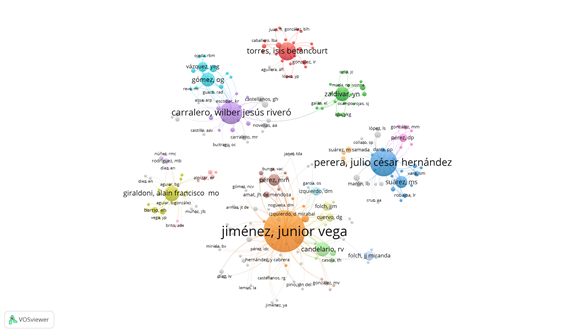
Fig. 1 - Knowledge map of the bibliometric study based on co-occurrence networks related to the authors and their profiles in Google Scholar (number of documents ≥ 1).
DISCUSSION
Alongside clinical care, it is recognized that the generation of scientific evidence directly influences informed decision-making, with a positive impact on improving population health. This process positions research as a fundamental pillar of the medical profession, whose development should be fostered from the initial stages of training. (1,4)
On the other hand, the measurement of scientific output has been analyzed in various medical disciplines, given that its evaluation is crucial for the allocation of clinical and teaching positions, the funding of research projects, the awarding of academic prizes, and even the design of public policies. (3,7)
The results obtained through bibliometric analysis of publications allow for the identification of trends in the scientific productivity of internists, the introduction of improvements that optimize its management, and the establishment of policies aimed at enhancing their results. (1,10)
In the present research, the concentration of candidates in Havana coincides with studies that link scientific productivity to institutional resources. (1,11) However, the higher number of PhDs in that province may be due to a greater number of applicants or a favorable trend toward professional development.
The predominance of assistant researchers suggests a generational transition, similar to that observed in evaluations of Spanish medical societies. (1) However, the low representation of researchers under 40 years of age (11,54 %) highlights the need to integrate young researchers, as recommended by UNESCO. (11)
The high number of scientific events in Santiago de Cuba could be related to local training initiatives, although the low rate of publication in indexed journals indicates a gap between dissemination and written production. This coincides with findings in developing countries, where the lack of resources to publish in high-impact indexed journals is a frequent obstacle. (9,12,13) This suggests the need for training in scientific writing and access to international journals.
The g-index is a bibliometric indicator that, like the h-index, quantifies scientific productivity based on authors' publication history. While the h-index prioritizes the balance between productivity and citations, the g-index gives greater weight to highly cited articles. (3,4,8,12) Junior Vega Jiménez's h-index of 15 and g-index of 22 exceed the average reported in similar studies of internists, (1,13) reflecting a significant relative impact. However, the lack of interprovincial collaboration among internal medicine branches or chapters underscores a structural challenge, similar to that observed in Cuban endocrinology research, (9) which highlights the need for policies that promote research networks to strengthen science in peripheral regions.
The i10-index is a simplified metric that quantifies highly cited works. (8,12,14) In this case, Alain Francisco recorded an index The author has an i10 index of 39, but only 178 total citations, which presents an apparent inconsistency. To achieve an i10 index of 39, the researcher should have at least 39 publications with 10 citations each (i.e., a theoretical minimum of 390 citations linked exclusively to those works). The discrepancy is explained by the fact that the author's profile includes citations erroneously attributed by Google Scholar to publications by other researchers with similar surnames, distorting the actual count. After this analysis, Vega Jiménez emerges as the researcher with the highest i10 index in the evaluated context.
During the research, a recurring phenomenon was identified: variations in the spelling of authors' first and last names, which led to duplicate entries in the records when processed by the software. This inconsistency represents a methodological limitation that could affect both the accurate retrieval of scientific output and the reliability of academic performance indicators, with the consequent risk of underreporting in bibliometric analyses. The implementation of advanced metrics tools eliminated this bias, enabling the creation of more accurate and representative collaboration maps.
Figure 1 shows limited interaction among authors. The study of author collaboration is fundamental for elucidating research trends, as it allows for inferring patterns of behavior among authors who form alliances for the development of academic projects. (7,9,15)
In the co-authorship network analysis—based on the co-occurrence of authors—a minimum threshold (documents ≥ 1) was applied to determine the inclusion of participants. Those authors with a greater number of collaborative interactions exhibit a higher nodal degree, while the intensity and strength of these relationships are visualized by thicker lines in the graphical representations. The findings of this research, consistent with those reported by Martínez Martínez,<sup>9</sup> show that most authors maintain an independent profile with little connection within the analyzed network.
It is striking that collaboration among internists in the studied provinces is scarce. Collaborative exchange is only evident between Wilber and Zaldívar, who belong to the same SOCUMI chapter.<sup>5</sup> This situation constitutes a call to strengthen research ties among the candidates for the governing board, which would be fundamental to enhancing SOCUMI's scientific capacity in all its provincial chapters.
Scientific productivity is a fundamental indicator for evaluating academic impact and guiding decision-making in the medical field.<sup>1</sup> In the Cuban context, the Cuban Society of Internal Medicine (SOCUMI) needs to implement objective tools to assess the research performance of its members, particularly for the appointment of leadership positions, where evidence based on scientific output metrics is essential.
The relevance of this study lies not in its ability to recognize individual merits, but in its contribution of evidence that facilitates the design of strategies aimed at strengthening internal medicine research at the national level.
Study limitations:
Size and representativeness: The sample was limited to 26 candidates, excluding provinces without applicants, which could bias the geographic and academic representation.
Reliance on secondary data: Some information was extracted from publicly available curriculum vitae records, which implies a risk of underreporting or inaccuracies in self-reported metrics.
CONCLUSIONS
The scientific productivity of internists shows geographical disparities, with a predominance in Havana and Santiago de Cuba. This is compounded by limited interprovincial collaboration, factors that could restrict the specialty's scientific impact. Furthermore, high participation in academic events does not necessarily translate into high-impact publications, highlighting opportunities to optimize research quality through specific strategies. Consequently, it is a priority to design and implement policies that foster systematic interprovincial collaborations and promote the active integration of junior internists into established research projects.
BIBLIOGRAPHIC REFERENCES
1. Burbano Santos P, Miró Ó, Martín-Sánchez FJ, Fernández Pérez C, Casademont J. Scientific production and bibliometric impact of a representative group of Spanish internists with established research careers. Rev Clin Esp (Barc). [Internet] 2015 [cited 10/08/2025]; 215(7):371-9. Available in: https://pubmed.ncbi.nlm.nih.gov/26036422/
2. Pacheco Aispuro G, Rojas Jácome IB, Martínez Zamora CA, Gil-Ortiz Mejía C, Mader C, Castillo Rangel C, et al. Bibliometric Analysis: Six Decades of Scientific Production from a Nationwide Institution: Instituto de Seguridad y Servicios Sociales de los Trabajadores del Estado (ISSSTE) from Mexico. Healthcare (Basel). [Internet] 2023 [cited 10/08/2025]; 11(12):1725. Available in: https://pubmed.ncbi.nlm.nih.gov/37372844/
3. Urrunaga-Pastor D, Bendezu-Quispe G, Dávila-Altamirano D, Asmat MN, Grau-Monge J. Bibliometric analysis of scientific production on university social responsibility in Latin America and the Caribbean. F1000Research. [Internet] 2023 [cited 10/08/2025]; 12(1):1340. Available in: https://pubmed.ncbi.nlm.nih.gov/39086606/
4. Hernández-Ovalle JP, Rodriguez-Morales AJ, Jaramillo-Montoya IC, Hermosa-Sanchez JM, López-Marín JF, Bernal-Chica MC, et al. Scientific research in family medicine in Latin America: A bibliometric analysis. Aten Primaria. [Internet] 2025 [cited 10/08/2025]; 57(1):103090. Available in: https://pubmed.ncbi.nlm.nih.gov/39270473/
5. Sociedad Cubana de Medicina Interna. Elecciones SOCUMI [Internet]. La Habana: Sociedad Cubana de Medicina Interna; [Internet] 1999 [cited 11 Abril 2025]. Available in: https://especialidades.sld.cu/medinterna/sociedad-cubana-de-medicina-interna/elecciones-socumi/.
6. Mayor Guerra E, Sagaro del Campo NM. Producción científica sobre ciencias biomédicas en la provincia de Santiago de Cuba. Rev. cuba. inf. cienc. salud. [Internet] 2021 [cited 10/08/2025]; 32(2):1622. Available in: http://scielo.sld.cu/scielo.php?script=sci_arttext&pid=S2307-21132021000200008
7. Zacca-González G, Chinchilla-Rodríguez Z, Vargas-Quesada B, de Moya-Anegón F. Bibliometric analysis of regional Latin America's scientific output in Public Health through SCImago Journal & Country Rank. BMC Public Health. [Internet] 2014 [cited 10/08/2025]; 14(1):632. Available in: https://pubmed.ncbi.nlm.nih.gov/24950735/
8. Torres-Salinas D, Ruiz-Pérez R, Delgado-López-Cózar E. Google Scholar como herramienta para la evaluación científica. Profesional de la información. [Internet] 2009 [cited 10/08/2025]; 18(5):501-10. Available in: https://revista.profesionaldelainformacion.com/index.php/EPI/article/view/epi.2009.sep.03
9. Martínez Martínez AC, Martínez Rodríguez A. Producción científica de los investigadores del Instituto de Endocrinología indizada en SciELO Cuba/2014-2018. Rev Cubana Endocrinol. [Internet] 2020 [cited 10/08/2025]; 31(3):e227. Available in: http://scielo.sld.cu/scielo.php?script=sci_arttext&pid=S1561-29532020000300007&nrm=iso
10. Vega Jiménez J, Morales Pérez M, Vega Candelario R, Martin Tirado JC, Guedes Díaz R. Producción científica de los investigadores del hospital militar de Matanzas en la Revista Cubana de Medicina Militar. Rev Cub Medicina Militar [Internet] 2022 [cited 10/08/2025]; 51(4):e02202393. Available in: https://revmedmilitar.sld.cu/index.php/mil/article/view/2393/1632
11. UNESCO Science Report. 2021, the race against time for smarter development: Towards 2030. Paris: UNESCO Publishing; [Internet] 2021 [cited 10/08/2025]. Available in: https://digitallibrary.un.org/record/3945690?v=pdf
12. Pérez-Obregón BR, Menéndez-Pérez M, Morales-Hector FdlC, López-Gómez EdJ. Las revistas en acceso abierto: ¿Una ruta amigable o una ruta espinosa? Rev Inf Cient. [Internet] 2022 [cited 10/08/2025]; 101(1):e3564. Available in: http://scielo.sld.cu/scielo.php?script=sci_arttext&pid=S1028-99332022000100015&nrm=iso
13. Rodríguez Contreras, R. Análisis de la presencia digital e impacto de los investigadores de la Universidad de La Sabana en las plataformas académicas Google Scholar, ResearchGate y Academia.edu [Internet]. Universidad de Granada, España: Universidad de La Sabana; [Internet] 2024 [cited 10/08/2025]. Available in: https://digibug.ugr.es/handle/10481/90545
14. Murillo-Gonzalez D, Zapata R, López O. Análisis de los perfiles de investigadores de Panamá e indicadores bibliométricos de Google Scholar. Revista Española de Documentación Científica. [Internet] 2023 [cited 10/08/2025];46(1):e349. Available in: https://redc.revistas.csic.es/index.php/redc/article/view/1428/2248
15. Indicadores e índices de la producción científica [Internet]. Las Palmas de Gran Canaria: Universidad de Las Palmas de Gran Canaria, Biblioteca Universitaria; [2023] [cited 10/08/2025]. Available in: https://biblioteca.ulpgc.es/factor_impacto
Declaration of conflict of interest:
Authors Junior Vega Jiménez and Wilber Jesús Riverón Carralero explicitly declare their status as candidates for the national board of SOCUMI. To mitigate potential bias, they did not participate in the collection, validation, or analysis of their own bibliometric data. These tasks were performed by independent co-authors, ensuring objectivity in the evaluation of their scientific productivity. This process ensured the external validity of the data and eliminated the risk of overestimation or manipulation.
Authors' contributions:
HALG: Conceptualization, Data curation, Formal analysis, Research, Methodology, Project management, Supervision, Validation, Visualization, Drafting, Revision, and editing.
LGG: Conceptualization, Data curation, Formal analysis, Research, Methodology, Project management, Validation, Visualization, Drafting, Revision, and editing.
JVJ: Conceptualization, Data Curation, Research, Methodology, Project Management, Drafting, Revision, and Editing.
WJRC: Conceptualization, Data Curation, Research, Project Management, Validation, Revision, and Editing.
YSR: Conceptualization, Formal Analysis, Project Management, Validation, Revision, and Editing.
YER: Conceptualization, Formal Analysis, Research, Validation, Revision, and Editing.