RESEARCH ARTICLE
Knowledge about searching for scientific information among Family Medicine residents
Conocimientos sobre búsqueda de la información científica en residentes de Medicina Familiar
Jonatham Veliz González 1* https://orcid.org/0009-0001-8155-6945
Maria de los Angeles Camdepadrós Agusti 2 https://orcid.org/0000-0002-1077-8380
Odalys Blanco Aspiazu 3 https://orcid.org/0000-0002-3097-3116
1 University of Medical Sciences of Havana. Faculty of Medical Sciences of Artemisa. Adrián Sansaricq Teaching Polyclinic. Artemisa, Cuba.
2 University of Medical Sciences of Havana. Faculty of Medical Sciences of Mayabeque. Alberto Fernández Valdés Polyclinic-Hospital. Mayabeque, Cuba.
3 University of Medical Sciences of Havana. National School of Public Health. Havana, Cuba.
* Corresponding author: velizjonatham@gmail.com
Received: 10/12/2025
Accepted: 25/03/2026
Published: 28/03/2026
How to cite this article: Veliz-González J, Camdepadrós-Agusti MdlA, Blanco-Aspiazu O. Knowledge about searching for scientific information among Family Medicine residents. MedEst. [Internet]. 2026 [cited access date]; 6:e461. Available in: https://revmedest.sld.cu/index.php/medest/article/view/461
ABSTRACT
Introduction: Information literacy constitutes an articulated system of knowledge, skills, and practices that enable effective interaction with information resources within the context of Information and Communication Technologies. Postgraduate medical training must ensure the progressive acquisition of these competencies, fostering their consolidation during specialization.
Objective: To determine the knowledge of scientific information retrieval among Family Medicine residents at the "Tomás Romay" Teaching Polyclinic, Artemisa municipality, Cuba.
Methods: An observational, descriptive, and cross-sectional study was conducted. The study population consisted of 21 residents, and the sample comprised 17 who met the inclusion criteria. The variables analyzed were: year of residency, information needs, learning methods for information retrieval, use of search engines, and use of advanced search strategies. Data collection was carried out using a questionnaire adapted and validated by experts. Absolute and relative frequencies and 95% confidence intervals were calculated.
Results: 52.9% (9/17) of residents used information services to complete assignments and expand their knowledge. Independent learning predominated (82.4%; 14/17), followed by university training (64.7%; 11/17). More than half used search engines (64.7%; 11/17), but only 41.2% (7/17) employed advanced search strategies. Third-year residents showed less use of advanced strategies (33.3%) compared to first-year residents (50.0%).
Conclusions: The development of information search skills presents limitations associated with training factors. Motivation is geared toward immediate academic goals with little internalization as a professional habit. The lower use of advanced strategies among third-year residents highlights the need for interventions in later stages of specialization. Systematic information literacy strategies integrated into the teaching process are required.
Key words: Information literacy, internship and residency, family practice, information competency, information seeking behavior.
RESUMEN
Introducción: la alfabetización informacional constituye un sistema articulado de conocimientos, habilidades y prácticas que permiten interactuar eficazmente con los recursos informativos en el contexto de las Tecnologías de la Información y las Comunicaciones. La formación médica posgradual debe asegurar la adquisición progresiva de estas competencias, favoreciendo su consolidación durante la especialización.
Objetivo: determinar los conocimientos sobre búsqueda de información científica en residentes de Medicina Familiar del Policlínico Docente "Tomás Romay", municipio Artemisa, Cuba.
Métodos: se realizó un estudio observacional, descriptivo y transversal. El universo estuvo conformado por 21 residentes, y la muestra por 17 que cumplieron criterios de inclusión. Las variables analizadas fueron: año de residencia, necesidades de información, formas de aprendizaje para la búsqueda de información, uso de buscadores y utilización de estrategias de búsqueda avanzada. La recolección de datos se realizó mediante cuestionario adaptado y validado por expertos. Se calcularon frecuencias absolutas, relativas e intervalos de confianza al 95 %.
Resultados: el 52,9 % (9/17) de los residentes empleaba los servicios de información para hacer trabajos y ampliar conocimientos. Predominó el aprendizaje independiente (82,4 %; 14/17), seguido de formación universitaria (64,7 %; 11/17). Más de la mitad utilizaba buscadores (64,7 %; 11/17), pero solo el 41,2 % (7/17) empleaba estrategias de búsqueda avanzada. Los residentes de tercer año mostraron menor uso de estrategias avanzadas (33,3 %) comparado con primero (50,0 %).
Conclusiones: el desarrollo de la competencia búsqueda de información presenta limitaciones asociadas a factores formativos. La motivación se orienta hacia objetivos académicos inmediatos con escasa internalización como hábito profesional. El menor uso de estrategias avanzadas en residentes de tercer año alerta sobre la necesidad de intervenciones en etapas avanzadas de la especialización. Se requieren estrategias sistemáticas de alfabetización informacional integradas al proceso docente.
Palabras clave: Alfabetización informacional, educación de posgrado en medicina, medicina familiar y comunitaria, competencias informacionales, conducta de búsqueda de información.
INTRODUCTION
The consolidation of the Internet as the primary environment for accessing information has transformed the practice of modern medicine. Healthcare professionals face a growing volume of scientific literature that requires specific skills for its location, evaluation, and effective application (1, 2). In this context, information literacy (IL)—understood as the articulated system of knowledge, skills, and practices that allow for effective interaction with information resources—constitutes an essential competency for continuing medical education (3).
The development of IL in medical education involves the acquisition of four fundamental capacities: searching for, evaluating, processing, and communicating information (4). Among these, information retrieval represents the initial pillar, as it involves knowledge of documentary sources, the identification of descriptors, and the selection of efficient retrieval strategies (5). Medical training must ensure the progressive acquisition of these competencies from undergraduate studies, their consolidation during specialization, and their continuous updating throughout professional life (6).
In Cuba, Family Medicine (FM) is one of the main organizational forms of postgraduate training. The current residency program, implemented in 2023, promotes participation in research, although it does not sufficiently specify the components necessary for the development of information literacy (7). This omission is concerning, given that several international studies have documented limitations in the handling of scientific information among resident physicians, particularly in the use of advanced search strategies and specialized databases (8, 9, 10).
In the Cuban context, previous research has identified information gaps in the health sector (11, 12, 13); however, specific analyses of information literacy in medical residency remain scarce (14). Deficiencies in this competency can negatively impact evidence-based clinical decision-making, limit participation in scientific events, and generate methodological weaknesses in the final projects of the specialty.
Given this problem, the present study aimed to determine the knowledge of scientific information retrieval among Family Medicine residents at the "Tomás Romay" Teaching Polyclinic, Artemisa municipality, Cuba, in March 2025.
MATERIALS AND METHODS
An observational, descriptive, and cross-sectional study was conducted at the "Tomás Romay" Teaching Polyclinic, located in Artemisa municipality, Cuba, during March 2025. The study population consisted of the 21 Family Medicine residents enrolled at the institution. Non-probability convenience sampling was used, resulting in a sample of 17 residents who met the inclusion criteria and agreed to participate. Three residents were not included: one due to maternity leave and two due to lack of a device with internet access, a technological accessibility limitation that could have introduced selection bias.
The inclusion criteria were: residents enrolled in the specialty during the research period; not being on maternity leave or on temporary leave; having a smart device with internet access to administer the instrument; and signing the informed consent form. Voluntary refusal to participate was established as the exclusion criterion.
The variables analyzed were: year of residency (first, second, third); information needs (preparation of academic papers, expansion of knowledge, or both); learning methods for information retrieval (self-directed, peer-to-peer, university training, library courses, other); use of search engines (yes/no); and use of advanced search strategies (yes/no), the latter defined as the declared use of at least one technique from among: Boolean operators (AND, OR, NOT), quotation marks for exact phrases, filters by date or publication type, or controlled descriptors (MeSH) in specialized databases.
Data collection was carried out using a self-administered structured questionnaire, adapted from the original instrument by García-Hernández and Lugones (16) to assess information literacy knowledge among healthcare professionals. The questionnaire consists of 20 items distributed across four sections: sociodemographic characteristics (3 items), information needs (4 items), search sources and strategies (8 items), and assessment of information skills (5 items). Adaptation to the medical residency context was performed by three experts in research methodology and medical education (content validity by expert judgment), and a pilot test was administered to 5 residents from another institution to assess comprehensibility (these residents were not included in the final sample). The reliability of the adapted instrument, estimated using Cronbach's alpha coefficient, was 0.78.
The questionnaire was administered via Google Forms with a single access link. The data were exported to Microsoft Excel 2016 and analyzed using univariate descriptive statistics: absolute frequencies (n), relative frequencies (%), and 95% confidence intervals (95% CI) for proportions. Inferential tests of association were not performed due to the small sample size.
The research was approved by the Scientific Council and the Ethics Committee of the institution. Confidentiality was guaranteed, the data were used exclusively for academic purposes, and the principles of the Declaration of Helsinki were respected. All participants provided written informed consent.
RESULTS
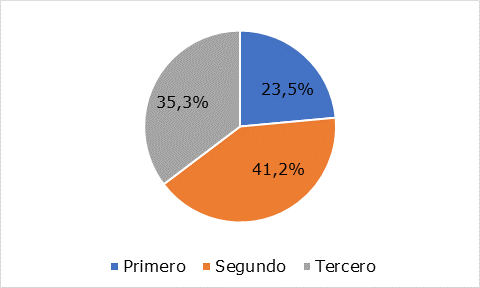
Analysis of the sample composition by year of training showed that second-year residents constituted the largest group, representing 41.2% (n=7) of the participants. (Figure 1)
Figure 1. Sample distribution by year of residency
Source: Individual questionnaire.
Regarding the use of information services to meet their needs, the most frequently reported reason was the combination of "doing work and expanding knowledge" (52.9%, n=9). (Table 1)
Table 1. Use of information services by residents according to their needs
|
Information needs |
Year of residence |
Total |
||||||
|
First |
Second |
Third |
||||||
|
No. |
% |
No. |
% |
No. |
% |
No. |
% |
|
|
Do academic work |
1 |
25,0 |
3 |
42,9 |
2 |
33,33 |
6 |
35,3 |
|
Expand knowledge |
1 |
25,0 |
0 |
0 |
1 |
16,67 |
2 |
11,8 |
|
Do assignments and expand knowledge |
2 |
50,0 |
4 |
57,1 |
3 |
50,00 |
9 |
52,9 |
Source: Individual questionnaire.
The predominant learning method was independent (self-directed) learning, reported by 82.4% (n=14) of respondents. No first-year residents reported using library training services. (Table 2)
Table 2. Learning methods used by residents for information retrieval
|
Learning methods |
Year of residence |
Total |
||||||
|
First |
Second |
Third |
||||||
|
No. |
% |
No. |
% |
No. |
% |
No. |
% |
|
|
Independently |
4 |
100,0 |
5 |
71,4 |
5 |
83,3 |
14 |
82,4 |
|
Through a friend |
0 |
0 |
4 |
57,1 |
3 |
50,0 |
7 |
41,2 |
|
At university |
3 |
75,0 |
4 |
57,1 |
4 |
66,7 |
11 |
64,7 |
|
Library user education courses |
0 |
0 |
2 |
28,6 |
2 |
33,3 |
4 |
23,5 |
|
Other |
2 |
50,0 |
3 |
42,9 |
3 |
50,0 |
8 |
47,1 |
Source: Individual questionnaire.
Regarding the use of search engines, more than half of the participants (64.7%) reported using them, with a higher frequency of use observed among first-year residents (75.0%). (Table 3)
Table 3. Use of search engines by residents, by year of residency
|
Use of search engines |
Year of residence |
Total |
|||||||
|
First |
Second |
Third |
|||||||
|
No. |
% |
No. |
% |
No. |
% |
No. |
% |
|
|
|
Yes |
3 |
75,0 |
4 |
57,1 |
4 |
66,7 |
11 |
64,7 |
|
|
No |
1 |
25,0 |
3 |
42,9 |
2 |
33,3 |
6 |
35,3 |
|
Source: Individual questionnaire.
Finally, it was found that only 41.2% of respondents used advanced search strategies, with third-year residents using them the least (66.7%) (Table 4).
Table 4. Use of advanced search strategies by residents
|
Capacity for use |
Year of residence |
Total |
||||||
|
First |
Second |
Third |
||||||
|
No. |
% |
No. |
% |
No. |
% |
No. |
% |
|
|
Yes |
2 |
50,0 |
3 |
42,9 |
2 |
33,3 |
7 |
41,2 |
|
No |
2 |
50,0 |
4 |
57,1 |
4 |
66,7 |
10 |
58,8 |
Source: Individual questionnaire.
DISCUSSION
The development of information literacy in postgraduate medical training is imperative for evidence-based practice in the 21st century. The results of this study reveal that, although most family medicine residents use general information services and search engines, less than half employ advanced search strategies. This gap between technological access and the ability to efficiently retrieve scientific information is not unique to the Cuban context; it coincides with findings reported in similar Latin American contexts (8, 9), and demonstrates a predominantly instrumental approach to information resources that limits the transformative potential of scientific evidence in clinical practice.
Identifying information needs represents the starting point for any effective search process (3). In this study, the duality between producing academic work and expanding knowledge as the main motivation (52.9%) reflects a utilitarian conception of information, where the academic-instrumental component predominates over continuous professional development. This trend, also observed in Cuban medical students (17) and Mexican residents (10), suggests that medical training has not yet internalized information literacy as a permanent professional habit, but rather as a specific response to curricular requirements. This limited understanding of information as a resource for solving immediate tasks, instead of as a tool for clinical reasoning and evidence-based decision-making, can perpetuate dependence on secondary sources and the mechanical application of protocols without a critical understanding of their evidence base.
Independent learning predominated as the means of acquiring skills (82.4%), followed by university training (64.7%). This finding, consistent with previous research in Cuba (17) and Spain (20), demonstrates a shift in the educational paradigm where residents assume greater autonomy in their training process. However, the complete absence of library courses in the first year (0%) and their limited overall use (23.5%) constitute a critical deficiency that reveals the disconnect between information services and training programs. Medical libraries represent strategic resources for information literacy training (30), and their underutilization has been documented in multiple Cuban provinces (27, 28, 29), suggesting a structural rather than a circumstantial problem. This situation demands a thorough review of the relationship between library services and teaching processes, moving beyond the traditional concept of document repositories toward active user education centers that support residents from their entry into the program until the completion of their specialization.
The preference for autonomous learning, while positive from the perspective of professional autonomy, carries significant risks when it is not based on solid methodological foundations. Self-directed learning requires a support structure that guarantees the quality of the processes of searching for, evaluating, and integrating information (18, 19, 23). Without this mediation, residents may fall into intuitive search patterns, replicate inefficient strategies, and, fundamentally, succumb to the illusion of information literacy that characterizes many users of the so-called "digital generation" (12). The available evidence indicates that self-perceived confidence in information skills frequently exceeds actual demonstrated competence (20), which constitutes an invisible obstacle to the recognition of training needs.
The use of general search engines (64.7%) without advanced search strategies (41.2% overall) replicates the pattern of "intuitive search" described in Latin American literature (8, 9). This search method, based on natural language searches and exploratory browsing, is insufficient when it is necessary to retrieve specific scientific evidence, filter large volumes of irrelevant information, or access literature of high methodological quality. The limited use of Boolean operators, controlled descriptors, and advanced filters not only reduces search efficiency but also increases the risk of availability bias, where the information retrieved depends more on popularity or accessibility than on its scientific relevance (10). In the context of medical practice, this bias can translate into clinical decisions based on incomplete or low-quality evidence.
Paradoxically, third-year residents showed less use of advanced search strategies (33.3%) compared to first-year residents (50.0%). This reversal of the expected trend, where academic progression should correlate with the deepening of skills, constitutes one of the most relevant findings of this study.
This reversal could be explained by multiple interrelated factors: (a) the progressive overload of clinical work in the final stages of residency, which reduces the time available for systematic updating and favors rapid searching over rigorous review; (b) the consolidation of simple search habits acquired in previous stages, which are maintained by inertia in the absence of formative feedback that challenges them; and (c) the possible disconnect between the increasing complexity of real clinical demands and the insufficient development of information literacy skills in the specialization curriculum. This phenomenon, not previously explored in the Cuban literature on medical training, warrants longitudinal research to understand the developmental trajectories of these competencies throughout the residency process.
The implications of this finding extend beyond the academic sphere. Third-year residents simultaneously face the task of writing their specialty theses, providing increasingly autonomous primary care, and frequently taking on mentoring roles for junior residents. Inadequate advanced search strategies at this critical stage can perpetuate cycles of poor training, where future specialists reproduce the same limited patterns in subsequent generations (25). This observation highlights the urgent need for training interventions specifically targeted at the intermediate and final stages of residency, countering the implicit assumption that information literacy skills develop spontaneously with clinical experience.
The limitations of this study must be explicitly acknowledged for a proper interpretation of its findings. The small sample size (n=17) and cross-sectional design prevent the generalization of results to other medical residency contexts or the establishment of temporal trends in skills development. The requirement of a device with internet access introduced a likely technological selection bias: the two residents excluded for this reason could represent precisely the subgroup with the greatest information limitations and least access to technological resources, implying that the identified deficiencies could be even more pronounced in reality.
Furthermore, the self-report questionnaire design may have introduced social desirability bias, particularly in responses regarding socially valued behaviors such as the use of advanced strategies, whose actual prevalence could be lower than reported. Finally, the lack of systematic pilot testing and reliability assessment of the adapted instrument constitutes methodological weaknesses that limit certainty regarding the internal consistency of the measurements.
From an educational perspective, these results demonstrate that the acquisition of information literacy skills does not occur spontaneously or linearly with academic progression, requiring systematic interventions integrated into the curriculum. Previous experiences in Cuban contexts have demonstrated the effectiveness of virtual teaching and learning environments (12), information literacy courses using platforms such as Moodle (15), and professional development strategies in the primary healthcare setting (13, 14) in significantly improving the selection of relevant resources, the use of biomedical databases, and the application of advanced search techniques. These interventions share common characteristics: they are systematic (not ad hoc), integrated into the teaching process (not parallel), mediated by information specialists (not self-administered), and their results are evaluated.
The pedagogical preparation of tutors emerges as a critical determinant in this process. Several studies have identified deficiencies in the information literacy training of the teachers themselves, which limits their capacity to support knowledge management (22, 23, 24). Effective research mentoring requires not only clinical experience but also explicit mastery of skills to access, evaluate, and synthesize scientific information, skills that can be modeled and transmitted in the daily pedagogical relationship. Investment in the training of trainers, therefore, represents a strategy for multiplying the impact on the quality of medical residency.
In summary, this study contributes to characterizing the current state of information literacy in a cohort of Cuban Family Medicine residents, identifying specific gaps between access to and effective use of scientific information, and highlighting the need to move beyond unmediated self-learning toward intentional, systematic, and evaluated training strategies. The finding of relative decline in advanced stages of residency serves as a warning for postgraduate programs that assume a linear progression of competencies and an invitation to design specific interventions for the professional consolidation period.
CONCLUSIONS
The development of information retrieval skills among Family Medicine residents at the "Tomás Romay" Polyclinic presents both training and organizational limitations. An instrumental use of resources predominates, with limited application of advanced strategies and motivation focused on immediate academic achievement. Autonomous learning is not mediated by specialists, perpetuating intuitive methods. Third-year residents exhibit lower competence, contradicting the expected progression. Systematic information literacy strategies, involving librarians and tutors, are required to improve training and the quality of professional practice.
BIBLIOGRAPHIC REFERENCES
1. Fernández-Valdés M de las M, Zayas-Mujica RG, Alfonso-Sánchez IR, Zacca-González G, Ponjuán-Dante G. Marco de referencia para la formación de competencias informacionales en el contexto cubano de las ciencias de la salud. Rev cuba inf cienc salud [Internet]. 2021 [citado 02/06/2025];32(4). Disponible en: http://scielo.sld.cu/scielo.php?script=sci_abstract&pid=S2307-21132021000400013&lng=es&nrm=iso&tlng=pt
2. González-Estrada G. La alfabetización informacional: un camino hacia la mejora del proceso de enseñanza-aprendizaje. Rev Cuba Inf En Cienc Salud [Internet]. 2021 [citado 02/06/2025];32(1):e1533. Disponible en: http://scielo.sld.cu/scielo.php?pid=S2307-21132021000100018&script=sci_arttext
3. Reche-Urbano E, Quintero-Ordóñez B, González-López I, Maldonado-Berea GA. Importancia de las competencias informacionales en educación superior. Comparativa España-México. REEC [Internet]. 2022 [citado 05/11/2025];(41):140–56. Disponible en: http://helvia.uco.es/xmlui/handle/10396/27376
4. Puig-Campmany M, Montiel-Dacosta JA, Higa-Sansone L, Ris-Romeu J. Docencia médica, formación especializada y Medicina de Urgencias y Emergencias (MUE): cuando el todo es más que la suma de las partes. Emergencias [Internet]. 2022 [citado 28/11/2025];34(4 (Agosto)):310–3. Disponible en: https://dialnet.unirioja.es/servlet/articulo?codigo=8503216
5. Hernández-González T, Amaró-Garrido MA, Martínez-Hernández AL. Competencias profesionales en tecnologías emergentes para las especialidades médicas. Revista Tecnología Educativa [Internet]. 2023 [citado 14/05/2025];8(1):52–62. Disponible en: https://tecedu.uho.edu.cu/index.php/tecedu/article/view/1154
6. Ministerio de Salud Pública. Programa de Especialidad de primer grado en Medicina Familiar. Universidad de Ciencias Médicas de La Habana. La Habana: Dirección Nacional de Posgrado; 2023.
7. Wazar-Puello JG, Fleck-Salado JL, Fiallo-de León JO, Vicente-Meléndez N, Rosario-Romero Y, Rodríguez D, et al. Impacto en la cultura investigativa de las competencias en investigación en residentes de término de especialidades médicas en el Centro Médico Universidad Central del Este. UCE Ciencia [Internet]. 2024 [citado 06/11/2025];12(3). Disponible en: https://uceciencia.edu.do/index.php/OJS/article/view/383
8. Chávez-Martínez O, Moctezuma-Paz A, Sosa-Bustamante GP, González AP, Paque-Bautista C. Análisis de competencias informacionales en médicos residentes. Rev Med Inst Mex Seguro Soc [Internet]. 2025 [citado 30/10/2025];63(6):e6748. Disponible en: https://revistamedica.imss.gob.mx/index.php/revista_medica/article/view/6748
9. Vargas-Echeverría SL, Pech-Argüelles RC. Evaluación diagnóstica de competencias informacionales en médicos residentes del Instituto Mexicano del Seguro Social. Rev cuba inf cienc salud [Internet]. 2025 [citado 14/05/2025];36:e2693. Disponible en: https://acimed.sld.cu/index.php/acimed/article/view/2693
10. Franco-Rico JA, Carrillo-Barragan BI, Espinosa-Alarcón PA. Habilidades informativas en médicos residentes de pediatría: validación de un instrumento y desarrollo de un Taller de Alfabetización Informacional en el IMSS. Investig bibl vol [Internet]. 2024 [citado 15/05/2025];38(98):121–43. Disponible en: http://www.scielo.org.mx/scielo.php?script=sci_abstract&pid=S0187-358X2024000100121&lng=es&nrm=iso&tlng=es
11. Alonso-Vazquez AV, González García DE, Despaigne-Despaigne I, Rodríguez-Portales A, Méndez-Leyva L, Mateo González I, et al. Competencias informacionales en los profesionales del Hospital Ginecobstétrico Docente en Palma Soriano, Cuba. EDUMECENTRO [Internet]. 2021 [citado 14/05/2025];13(3):147–61. Disponible en: http://scielo.sld.cu/scielo.php?script=sci_abstract&pid=S2077-28742021000300147&lng=es&nrm=iso&tlng=en
12. García-Martin D, Benedico-Aguilera Y, Pacheco-Limonta E, Riol-Hernández M, Diéguez-Batista R, Hernández-Rodríguez YH. Diseño y validación de un entorno virtual de enseñanza-aprendizaje como recurso didáctico de la alfabetización informacional. Rev cuba inf cienc salud [Internet]. 2021 [citado 14/06/2025];32(2):1–25. Disponible en: https://www.medigraphic.com/cgi-bin/new/resumen.cgi?IDARTICULO=107529
13. Jiménez-Puerto CL, Amaró-Garrido MA, González-Valdéz E, González-Consuegra JA. Estrategia de superación en competencia informacional para médicos especialistas en Medicina Familiar. RCIM [Internet]. 2025 [citado 04/11/2025];17:e847. Disponible en: https://revinformatica.sld.cu/index.php/rcim/article/view/847
14. González-García DE, Anaya-Gómez Y, Del Valle-Llagostera JG, Rivery-Chaveco R, Pérez-Martínez L. Gestión de competencias investigativas desde el aprendizaje móvil, solventa calidad de la superación en salud. Rev Ciencias Médicas [Internet]. 2023 [citado 03/11/2025];27(4):e5874. Disponible en: http://scielo.sld.cu/scielo.php?script=sci_abstract&pid=S1561-31942023000500009&lng=es&nrm=iso&tlng=pt
15. García-Martín D, Carrera-Martínez JL, Riol-Hernández M, Diéguez-Batista R. Impacto del binomio alfabetización informacional e investigación científica en residentes de Angiología y Cirugía Vascular. Rev Cubana Angiol Cir Vasc [Internet]. 2024 [citado 04/05/2025];25:e465. Disponible en: http://scielo.sld.cu/scielo.php?script=sci_abstract&pid=S1682-00372024000100003&lng=es&nrm=iso&tlng=en
16. García-Hernández X, Lugones-Botell M. Conocimientos sobre alfabetización informacional en profesionales de la salud. Rev Cubana Med Gen Integr [Internet]. 2013 [citado 18/09/2025];29(1):27–35. Disponible en: http://scielo.sld.cu/scielo.php?script=sci_abstract&pid=S0864-21252013000100005&lng=es&nrm=iso&tlng=pt
17. Ramos-Bermúdez JF, Ramos-Calás M. Competencias informacionales en estudiantes de Medicina de Las Tunas. MEDISAN [Internet]. 2025 [citado 03/05/2025];29(0):5063. Disponible en: https://medisan.sld.cu/index.php/san/article/view/5063
18. Díaz-Chieng LY, Rodríguez-Torres E, Pérez-Sevila Y, Macías-Bestard C. Competencias informacionales y motivación: Referentes teóricos en la enseñanza médica superior. Episteme Koinonía [Internet]. 2025 [citado 02/06/2025];8(15):28–44. Disponible en: http://ve.scielo.org/scielo.php?script=sci_abstract&pid=S2665-02822025000100028&lng=es&nrm=iso&tlng=es
19. Barbosa-Chacón JW, Martínez-Líbano J, Lira MM. Competencias informacionales en la formación inicial docente: una revisión sistemática de la literatura. IB [Internet]. 2025 [citado 05/11/2025];39(102):109–34. Disponible en: http://www.rev-ib.unam.mx/ib/index.php/ib/article/view/58946
20. Domínguez-Aroca MI, Toro Flores R, Gómez-González JL. Evaluación de las competencias informacionales al inicio y al final del grado en titulaciones de ciencias y ciencias de la salud de la Universidad de Alcalá y el papel de la biblioteca universitaria. An Documentación [Internet]. 2023 [citado 02/06/2025];26(1). Disponible en: https://dialnet.unirioja.es/servlet/articulo?codigo=9205788
21. Méndez-Sandoval NR, López-Ramirez LA, Estrada-Andrade ME, Muñoz-Cortés G. Aprendizaje autodirigido en residentes de medicina familiar: formación en investigación y tasas de aceptación en publicaciones científicas. AMF [Internet]. 2025 [citado 28/11/2025];27(3):105–12. Disponible en: http://archivosenmedicinafamiliar.com/index.php/AMF-2023-06/article/view/150
22. González-Consuegra JA, Amaró-Garrido MA, González-Ledesma AF, González-Valdéz E, Jiménez-Puerto CL. Competencias informacionales en profesores de ciencias médicas del municipio de Fomento. MEDICIEGO [Internet]. 2025 [citado 28/11/2025];31:e-4208. Disponible en: https://revmediciego.sld.cu/index.php/mediciego/article/view/4208
23. Amaró-Garrido MA, Díaz-Quintanilla CL, Cubilla-Quintana F, Hernández-González T, Solenzal-Alvarez YT, Martínez-Hernández AL. Formación docente en los médicos de la atención primaria de salud. EDUMECENTRO [Internet]. 2023 [citado 27/11/2025];15:e2312. Disponible en: http://scielo.sld.cu/scielo.php?script=sci_abstract&pid=S2077-28742023000100032&lng=es&nrm=iso&tlng=pt
24. Rizo-Vázquez AC, Pérez-Lemus JF, Taureaux-Díaz N, Gasca-Hernández E, Román-Pleins R, Cejas Valdés L de los Á, et al. Caracterización del tutor como figura central en la formación del médico general integral. Educ Med Super [Internet]. 2021 [citado 22/10/2025];35(3):e2248. Disponible en: http://scielo.sld.cu/scielo.php?script=sci_abstract&pid=S0864-21412021000300004&lng=es&nrm=iso&tlng=es
25. Prieto-Peña AI, González-Sánchez A, Díaz-Díaz AA. Importancia social de la preparación pedagógica del tutor en la formación del médico general integral. RevMedElectrón [Internet]. 2023 [citado 27/11/2025];45(3):486–99. Disponible en: http://scielo.sld.cu/scielo.php?script=sci_abstract&pid=S1684-18242023000300486&lng=es&nrm=iso&tlng=es
26. Ramírez-López B. Apuntes históricos sobre del proceso de formación del médico general integral en Cuba. MEDISAN [Internet]. 2022 [citado 22/10/2025];26(2):475–87. Disponible en: http://scielo.sld.cu/scielo.php?script=sci_abstract&pid=S1029-30192022000200475&lng=es&nrm=iso&tlng=es
27. Veliz-González J, Chirolde-Rojas ME, Díaz-Beltran MD, Arencibia-Parada NM. Utilización de la biblioteca médica por residentes de Medicina Familiar. Rev Ciencias Médicas [Internet]. 2025 [citado 30/11/2025];29(1):e6941. Disponible en: https://revcmpinar.sld.cu/index.php/publicaciones/article/view/6941
28. Pérez-Herrera MJ, Cruz-Morales N, Morgado-Bonachea I. Gestión bibliotecaria en el Centro Provincial de Información de Ciencias Médicas de Ciego de Ávila durante la COVID-19. MEDICIEGO [Internet]. 2022 [citado 06/11/2025];28(1):e3323. Disponible en: https://revmediciego.sld.cu/index.php/mediciego/article/view/3323
29. Rodríguez-Reyna R, Gutiérrez-López JI. Uso de la biblioteca médica por residentes de Medicina General Integral del municipio de Niquero. Gac Méd Espirit [Internet]. 2021 [citado 15/05/2025];23(2):18–26. Disponible en: http://scielo.sld.cu/scielo.php?script=sci_abstract&pid=S1608-89212021000200018&lng=es&nrm=iso&tlng=en
30. Aguila-García O, Peña-Jiménez L, Pérez-Quintero M, Fernández-Pérez L. Evaluación de la gestión de calidad en la red de bibliotecas médicas de Villa Clara. Medicent Electrón [Internet]. 2023 [citado 30/10/2025];27(4). Disponible en: http://scielo.sld.cu/scielo.php?script=sci_abstract&pid=S1029-30432023000400016&lng=es&nrm=iso&tlng=en
AUTHORSHIP STATEMENT
JVG: Conceptualization, data curation, research, methodology, project management, resources, software, supervision, validation, visualization, drafting, writing, revision, and editing of the final work.
MACA: Conceptualization, research, methodology, validation, original drafting, and revision.
OBA: Conceptualization, methodology, validation, and revision.
CONFLICT OF INTEREST
The authors declare that there is no conflict of interest.
FUNDING SOURCES
The authors declare that they received no funding for the development of this research.
USE OF ARTIFICIAL INTELLIGENCE
The authors declare that artificial intelligence was not used in the writing of this manuscript.